
This White Paper compiles documented critiques about Alpha, its practices and its organization to help pastors and church leaders exercise biblical discernment, as commanded in 1 Thessalonians 5:21 and Acts 17:11.
What is Alpha?
The Feb. 9, 1998, issue of Christianity Today explained the acronym ALPHA:
A—Anyone interested in finding out more about the Christian faith;
L—Learning and Laughter;
P—Pasta (eating together gives people the chance to know each other);
H—Helping one another (small groups are used for discussion of issues raised during the lectures);
A—Ask anything. No question is seen as too simple or too hostile.”
The Alpha Course was started in the United Kingdom, at Holy Trinity Brompton Church in 1977. This church was part of the Toronto Blessing signs and wonders movement, and has been known for services that include being “slain in the spirit” and behaviors such as uncontrollable laughter, spasms, loud animal-like noises and physical manifestations during emotionally driven services. In some cases, these elements have found their way into the teachings of this course.
Alpha intentionally knows no denominational boundaries. Roman Catholics, Evangelicals, Anglicans, Methodist, Congregationalist, United Reformed, Pentecostal, Salvation Army, Baptists, Presbyterian, Charismatic Fellowships, and Evangelical Free Churches all run Alpha Courses. Having attracted 28.5 million participants since 1993, the Alpha Course is advertised as a non-confrontational means of sharing the truths of the Christian faith.
Among the many more prominent leaders to endorse ALPHA are Rick Warren, Bill Hybels, Tony Campolo, Tim Keller, J. I. Packer and others. Time Magazine, in a 2012 article titled, Alpha Course Will Continue Rebranding Christianity, compared Alpha’s creator, Nicky Gumbel, to a Billy Graham for the modern age. Gumbel was also a member of Tony Blair’s Faith Foundation.
Alpha presents itself as an introduction to Christianity through shared meals, video teaching, small-group discussion, and a Holy Spirit Weekend retreat to experience the Holy Spirit. However, when evaluated against Scripture, significant theological and methodological concerns emerge.
Concern: Doctrinal Ambiguity
A central concern is Alpha’s presentation of the gospel itself:
- Sin is often softened—described as “brokenness” or “mistakes”—rather than defined as willful rebellion against a holy God under His righteous judgment (Romans 1:18; 3:23; Ephesians 2:1–3).
- Repentance and faith are not clearly emphasized from the outset. Participants may be encouraged toward an early “commitment,” creating the impression that salvation comes through a one-time prayer rather than genuine repentance and new birth.
- Christ’s atoning work is frequently framed in terms of God’s love, with far less clarity on substitutionary atonement and the satisfaction of divine justice.
- Eternal judgment is downplayed or minimized.
The late Ken Silva of Apprising Ministries observed:
“Alpha is fully ecumenical and thoroughly charismatic in content. Three of the fifteen talks center on the Holy Spirit – including a primer on ‘tongues’ – with another entirely dedicated to ‘healing’. Only two talks focus on Jesus Christ, with none at all on God the Father.
Alpha’s actual ‘gospel’ content is minimal. Talk one is about the meaning of life and the relevance of Christianity. Talk two presents historical evidence for the reliability of the Bible as a true record of the life, death and resurrection of Jesus. From talk four onwards, Alpha treats the audience as if it were Christian and deals with topics such as assurance, the will of God and prayer. That leaves talk three, entitled ‘Why Did Jesus Die?’, as the only direct Gospel section in the whole course. From this chapter, the ‘gospel according to Gumbel’ can be summarized as follows:
The root cause of sin is a broken relationship with God.
Everyone has done bad things and consequently our lives are in a mess.
Sin has polluted us and will ultimately lead to eternal isolation from God.
God loves us and longs to restore our lost relationship with Him.Although Gumbel mentions sin over thirty times in talk three, he presents it almost entirely as something people do, omitting an explanation of what people are by nature. People do what they do because they are what they are. They sin because they are sinners. Yet, apart from writing ‘Gen 3’ in brackets at one point, Gumbel skips any exposition of the doctrine of original sin – how sin entered the world through our first parents’ rebellion in the garden of Eden (Rom 5:12-19). His audience is not informed that by Adam’s disobedience all have been constituted sinners. No Alpha attendee learns that they were therefore conceived in sin and born with a depraved principle of evil permeating their very nature (Psa 51:5, Eph 2:3, Isa 48:8, Psa 58:3, Gen 8:21, John 3:6, Rom 7:18).”
Concern: Ecumenical Framework
One of the most serious concerns with Alpha is its intentional ecumenical approach. The course is designed to unite participants across denominational lines, often by minimizing doctrinal distinctions. While biblical unity among true believers is important, that unity must never come at the expense of essential doctrine—especially the Gospel itself.
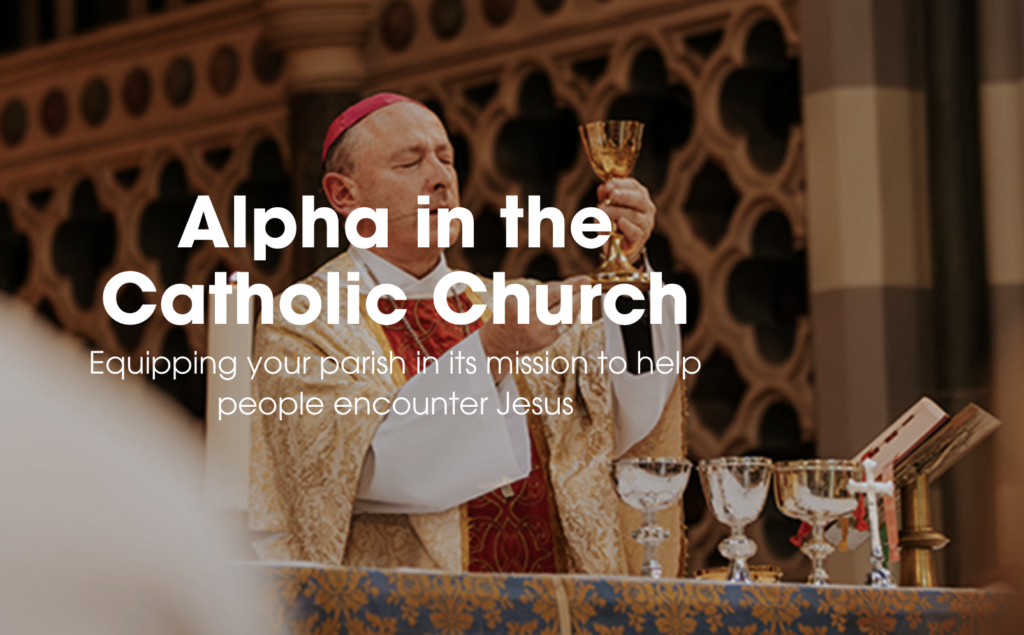
An Alpha for Catholics program was created back in 1996 after Cardinal Basil Hume invited Alpha pioneers Nicky Gumbel and Sandy Millar to a lead an Alpha conference at Westminster Cathedral. From there, Alpha spread rapidly through Roman Catholic parishes around the world and is now used in Catholic churches in more than 65 countries. In 2012, Alpha USA took this ecumenical partnership a step further by appointing Roman Catholic Bishop Michael Byrnes to its Board of Directors.
Alpha for Catholics is not only presented as an evangelism tool, but also as a refresher for practicing Catholics and a pathway for lapsed Catholics to return to the Roman Catholic Church. Alpha leadership has repeatedly emphasized common ground over theological differences. But those differences are not minor. They include foundational doctrines such as justification by faith alone—the very issue at the heart of the Reformation. The Council of Trent directly condemned justification by faith alone in Canon 9: “If anyone says that the sinner is justified by faith alone, meaning that nothing else is required to cooperate in order to obtain the grace of justification, and that it is not in any way necessary that he be prepared and disposed by the action of his own will, let him be anathema.“
This is not a secondary issue. Rome officially anathematized the doctrine of justification by faith alone. For Alpha to position itself as equally at home in both Protestant and Roman Catholic settings should raise serious concerns for pastors tasked with guarding doctrinal truth. As Erin Benziger wrote in The Ecumenical Compromise of the Alpha Course,
“Here again we see the egregious error of ecumenical compromise. As has already been demonstrated, the Roman Catholic Church stands in opposition to the true, saving Gospel of Jesus Christ. As such, it cannot “work together” with Protestants and Evangelicals ‘to further the Good News of Jesus Christ.’ Such partnering cannot occur because Rome long ago trampled on that Good News.”
Scripture is clear in warning against doctrinal compromise, especially where the Gospel itself is concerned (Galatians 1:6–9; 2 Corinthians 6:14–18).
Roman Catholicism is not the only concern. GotQuestions.org also notes that Alpha has sometimes been used to promote other problematic teachings:
“Some teachers have used the Alpha Course to teach “kingdom now” theology, which is also called “dominionism” or “triumphalism.” This is the idea that those who have enough faith can enjoy right now all or most of the physical and health benefits promised during the coming Millennial Kingdom of Christ on earth. This is nothing more than the “health, wealth, and prosperity” gospel repackaged with a new name. Wealth, health and good times are promised in the name of “faith.” This treats God like a spiritual ATM who must give what we ask, rather than a holy God deserving of our submission to His perfect will and His sovereign purpose. With a teacher from this persuasion, the Alpha Course can be used to promote the idea that the Holy Spirit can be called upon to perform His works in response to man’s demand.
Whether the compromise comes through Roman Catholicism, prosperity teaching, or charismatic excess, the concern remains the same: Alpha’s broad ecumenical structure makes it highly adaptable to teachings that conflict with sound doctrine.
Concern: Charismatic Experiences Over Truth
Another major concern is Alpha’s emphasis on experience—specifically the kind of emotionally driven, charismatic-style worship that is so popular today. The course includes a “Holy Spirit Weekend” that focuses heavily on experiences such as speaking in tongues, being “slain in the spirit,” and other physical manifestations. This focus on producing a particular kind of experience can confuse new believers about what genuine spiritual transformation actually looks like.
These emphases are not accidental. Alpha has historical ties to the charismatic renewal movement, including influence from John Wimber, founder of the Vineyard Churches, and the broader signs and wonders ministry culture of Holy Trinity Brompton. Wimber’s ministry shifted the focus of the Gospel away from repentance and atonement and onto experiences. You can see his influence on Gumbel and Alpha.
In the Personal Freedom Outreach article “The Alpha Course – Final Answer or Fatal Attraction?” the author writes, “Gumbel unashamedly is trying to move people into esoteric experiences, altered states of consciousness, self-hypnosis and mindless emotionalism and then tell his followers it is all of God. Gumbel uses “God’s words” to move people toward the ultimate end which is hysteria, loss of control, and mindlessness.”
Nicky Gumbel has openly encouraged participants to expect and experience these kinds of manifestations during the Holy Spirit weekend—including a loss of normal self-control. Gumbel has said that the purpose of the Holy Spirit weekends is to expect all kinds of strange manifestations and bodily agitations, as reported in The Christian Research Network Journal, now archived
“Sometimes, when people are filled, they shake like a leaf in the wind. Others find themselves breathing deeply as if almost physically breathing in the Spirit. … Physical heat sometimes accompanies the filling of the Spirit and people experience it in their hands or some other part of their bodies. One person described a feeling of ‘glowing all over’. Another said she experienced ‘liquid heat’. Still another described ‘burning in my arms when I was not hot’.”
But this raises serious questions: Is this the Holy Spirit in God’s Word? Where does Scripture ever teach that the Holy Spirit causes believers to lose control of their bodies?
In fact, Scripture teaches the opposite: “For God is not a God of confusion but of peace” (1 Corinthians 14:33). The fruit of the Spirit includes self-control—not hysteria, not chaos, and not altered states of consciousness.
When experiences are elevated above truth, discernment is the first casualty. And when new believers are taught to chase manifestations rather than understand Scripture, the result is confusion—not maturity.
Concern: Pragmatism
 Gone are the days of outdated media. Today, participants can access Alpha instantly through a smartphone or tablet using the MyAlpha app.
Alpha has been adapted for use in prisons, universities, workplaces, and churches around the world. Its structure—high-quality video production, shared meals, and relational discussion—has proven highly effective at drawing people in. But effectiveness is not the same as faithfulness. Alpha’s methodology reflects a pragmatic approach that often prioritizes engagement over doctrinal precision. For instance, Alpha Youth provides fast-paced videos intended to appeal to this generation, according to its website:
“The content is relevant, relatable, and designed to meet young people where they are. Whether it is hosted in a school, youth group, or community setting, Alpha Youth helps young people feel seen, heard, and free to ask their biggest questions in a safe and welcoming environment.”
The issue is not the use of technology itself. The concern is whether this highly polished, entertainment-driven format leads to a softened message—one that avoids hard truths in order to keep the environment comfortable and appealing. Scripture calls us to proclaim the full counsel of God (Acts 20:27)—not a curated, comfortable version of it. The true Gospel will confront, convict, and divide (Matthew 7:13–14, 21–23). When methodology drives the message, the message itself is often the first thing compromised.
A method that requires the message to be softened in order to succeed is not a method the Church should adopt.
Conclusion:
Even when Alpha appears to produce positive results, pastors and elders are called to evaluate those outcomes in light of Scripture—not appearances. The Bible warns repeatedly about false assurance and charges church leaders with guarding the flock (Acts 20:28–31; 2 Timothy 4:1–5). Good intentions and visible response do not validate a method if the message itself is unclear or incomplete.
Using Alpha without significant modification introduces doctrinal concerns into the teaching ministry of the church. Attempting to “fix” it often requires rewriting large portions of the material—raising a simple question: why use it at all?
For these reasons, churches should approach Alpha with extreme caution—and in many cases, avoid it altogether. Its accessible format and broad appeal do not outweigh the concerns regarding doctrinal ambiguity, experiential emphasis, and ecumenical compromise.
The Gospel does not need to be softened to be effective. Scripture itself is sufficient. The clearest and most faithful approach to evangelism remains the straightforward teaching of God’s Word—verse by verse—paired with personal discipleship and a commitment to sound doctrine.
Pastors are not called to follow trends. They are called to preach the Word, to correct error, and to protect the flock entrusted to their care. That responsibility requires discernment, courage, and a willingness to reject methods that compromise clarity for the sake of appeal.
The aim of Berean Research is not to criticize for its own sake, but to contend for the faith once delivered to the saints (Jude 3). Discernment is not divisive—it is necessary. And protecting the truth of the Gospel is one of the most loving things the Church can do.
Additional reading
- The Ecumenical Compromise of the Alpha Course – Erin Benziger, Apprising Ministries
- The Dangers Of The Alpha Course – Deception in the Church
- What is the Alpha Course? – www.gotquestions.org
- The Alpha Course – Michelle Lesley
- Alpha Exposed: Part 1
- Alpha Exposed: Part 2
- Alpha Exposed: Part 3
- Does the Alpha Course Teach the Truth?
- “The Alpha Course – Final Answer or Fatal Attraction?”
- What is the ALPHA Course?