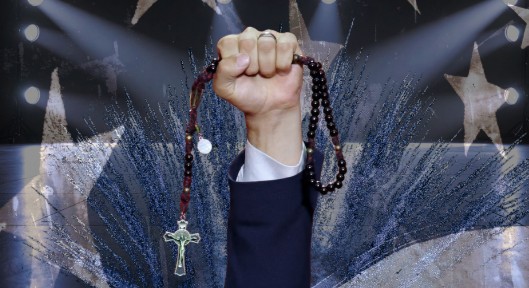
I recently wrote about what is often presented as a newer expression within the visible Church titled, Christian Nationalism: Why You Should Ask Questions, a movement which has been forming some religious affiliations and partnerships that the Bible warns us ought not be.
 Christian Nationalism is often described as falling along a spectrum, but when defined by its own leaders and theological advocates, it takes the focus off the mission of the Bride of Christ and places it elsewhere. It’s a specific identity as well as a theological and political ideology that seeks to ‘bring the Kingdom of God to earth’ — language commonly used within dominionist and Kingdom Now circles — through coercive laws and cultural dominance to bring about a so-called Golden Age of Christian dominance before or (in a growing normalcy of cases) “so that” – Christ can return. Bringing Christ back as king of our political cause is the Dominionism’s end game.
This is NOT about patriotism, or voting and standing up for what’s right and against what’s wrong. We all should do this in obedience to God. Christian Nationalism is about control and coercion, which is opposite from spreading the Good News of the Gospel.
Ecumenical Syncretism: Pursuing Unity through Theological Compromise
Religious syncretism is the blending of theological beliefs and practices. Ecumenicism, or ecumenicalism (both terms are commonly used), is about people and organizations. It refers to efforts aimed at visible unity across Christian traditions. However, in its modern expressions — particularly in political and cultural movements — it often extends beyond Christianity itself, blending believers with non-Christians, adherents of other religions, and even false teachers within the visible church. All with the intention of promoting the need to gather under a single banner of faith for the purpose of unity around a political or moral cause rather than shared biblical doctrine.
Religious syncretism and ecumenicism are simply not compatible with true Christianity. In fact, any modification to our biblical mission for the sake of a “better” outcome is not just a dangerous path. It is spiritual adultery. That may sound like divisive rhetoric, but Scripture itself uses this language, not as an insult, but as a warning meant to call God’s people back to faithfulness.
 2 Kings 17:35-36 warned the Israelites, “You shall not fear other gods or bow yourselves to them or serve them or sacrifice to them, but you shall fear the Lord, who brought you out of the land of Egypt with great power and with an outstretched arm. You shall bow yourselves to him, and to him you shall sacrifice. And the statutes and the rules and the law and the commandment that he wrote for you, you shall always be careful to do.”
Deuteronomy 12:29-31 says, “When the Lord your God cuts off before you the nations whom you go in to dispossess, and you dispossess them and dwell in their land, take care that you be not ensnared to follow them, after they have been destroyed before you, and that you do not inquire about their gods, saying, ‘How did these nations serve their gods? — that I also may do the same.’
You shall not worship the Lord your God in that way, for every abominable thing that the Lord hates they have done for their gods, for they even burn their sons and their daughters in the fire to their gods. “
Keep in mind that the Roman Empire famously tolerated a wide array of cults and mystery religions, provided they did not challenge imperial authority. Christianity was not left unscathed. The Apostles and the earliest generations of believers not only spread the Gospel but also labored diligently to guard its doctrinal integrity against syncretism and compromise.
 The temptation and threat of syncretism is still with the church today. Non-Christian philosophies and movements — such as Marxism, existentialism, New Age spirituality, Word of Faith teaching, the New Apostolic Reformation (NAR), and others — have repeatedly sought to harness the moral authority and cultural power of Christianity in order to advance agendas foreign to the Gospel. Ecumenical Syncretism continues to be a powerful tool to separate God from His people by redefining faithfulness as unity, obedience as activism, and truth as consensus. And right now we are seeing this happen among certain groups aligned with Christian Nationalism who are joining hands with leaders and organizations in order to gather in faith under the banner of Christian unity to take back our nation and our world for Christ. And as great as that might sound to our ears, this is not our biblical mission.
The Kirk Effect
These alliances have been forming for decades, but they have accelerated dramatically in the period following the assassination of Charlie Kirk. Charlie was the founder of Turning Point USA, or TPUSA, which many discernment ministries and critics have identified as operating within a Christian Nationalist framework focused on political issues and advocacy. It also has a religious arm called TPUSA Faith.
This organization has exploded with new chapters and conferences not only in the United States, but also around the world.

One positive outcome is that in the weeks and months since Charlie was killed, many people who’ve never committed to attending church before are now very interested in learning about Jesus and seeking out churches to attend – and that is a good thing. Praise God that He has drawn so many to hear the Gospel. In the media, this has been referred to as the “Charlie Kirk Effect.” There’s no way to verify the numbers of new attendees filling the pews, but you can see the swell of participation in the TPUSA events – especially at the memorial service late last year. The organization says it has more than doubled in size since last September after Charlie was killed. 4,000 new churches have joined their network and 200,000 individual people have signed up to join TPUSA Faith.
 Many are calling this phenomenon a revival. True revival is accompanied by belief in Christ for the forgiveness of sins, and repentance. The fruit of that faith takes some time to develop, and we do want to be careful about labelling any event a revival. But God can and does use tragic events for His good purposes, and we want to – in all humility – thank Him for loving humanity while we were still sinners, and saving His children for His own. Our faith is rooted in the proclamation of the Gospel, the teachings of Scripture as 100 percent true, and personal transformation through the indwelling of the Holy Spirit.
Many sincere Christians support TPUSA believing they are defending truth and liberty. However, beneath the surface of its political messaging are theological influences and patterns that deserve careful scrutiny — specifically Dominion theology, New Apostolic Reformation or NAR influence, and a growing ecumenical blurring of doctrine.
The concern I have is the ecumenical nature of TPUSA’s events, tours, and partnerships, which often feature speakers and collaborators from diverse religious backgrounds and prioritize conservative political alignment over theological agreement. We’ve seen this on display at major gatherings such as AmFest 2025, the Courage Tour (promising a Third Great Awakening), pastors’ summits, the upcoming Make Heaven Crowded tour, and similar events.
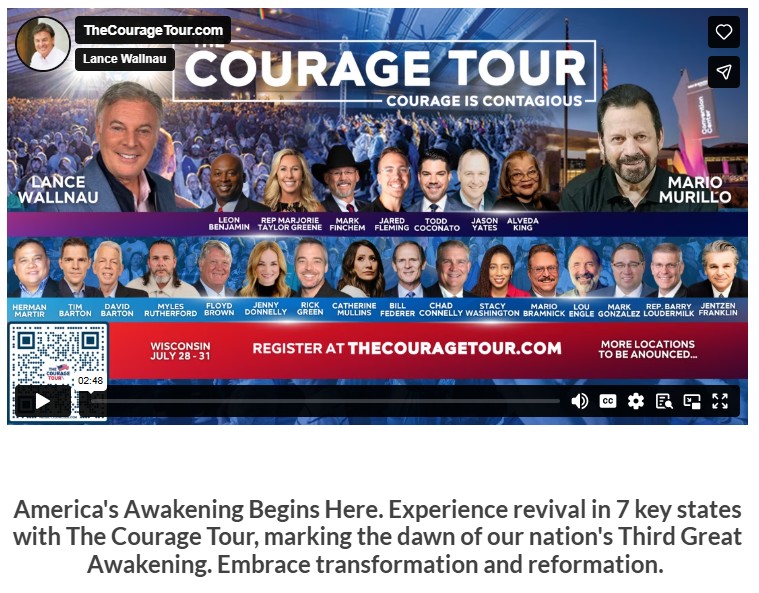
This willingness to partner with false teachers, as defined by Scripture rather than political alignment, and join hands with speakers who are not people Christians should be listening to, all in the name of a political win or a cultural victory, is hugely concerning.
When political activism masquerades as a kingdom mission, when political success becomes framed as obedience to God, Christians are quietly lulled away from the Gospel and toward a humanistic power-centered Christianity – which is no Christianity at all.
TP USA Faith
 Turning Point USA added a new chapter in 2021 called Faith. Its mission is to “equip the faith community to be culturally and civically engaged like never before, by inspiring and empowering pastors and their congregations to stand for the biblical values that our nation was founded upon” (TPUSA Faith mission statement). TPUSA Faith’s political goals have increasingly been framed in spiritual and prophetic terms, TPUSA Faith leaders have used language such as, “Taking back the nation,” “Spiritual warfare for America,” and “God’s mandate for cultural control.” While these phrases may appear patriotic, this language does not come from the Bible — it comes from dominionist, Kingdom Now theology within the NAR. And it is being normalized thanks to this growing organizational network of powerful voices and platforms.
The Book of Revelation gives us a prophetic warning about the rise of a one-world religious system in the last days, symbolized by the harlot in Revelation 17. This system represents a false, apostate religion that deceives the world and aligns itself with political powers, having the power to lead millions to forsake the Gospel truths and follow deceiving spirits. It warns that there will come a time when the world gives up the true exclusive Gospel of Jesus Christ for another gospel, a more inclusive gospel suited for the one-world religion. While Christians can debate the specifics of end-times events, Scripture clearly teaches that any religious system aligning with political powers at the expense of the Gospel risks deceiving millions.
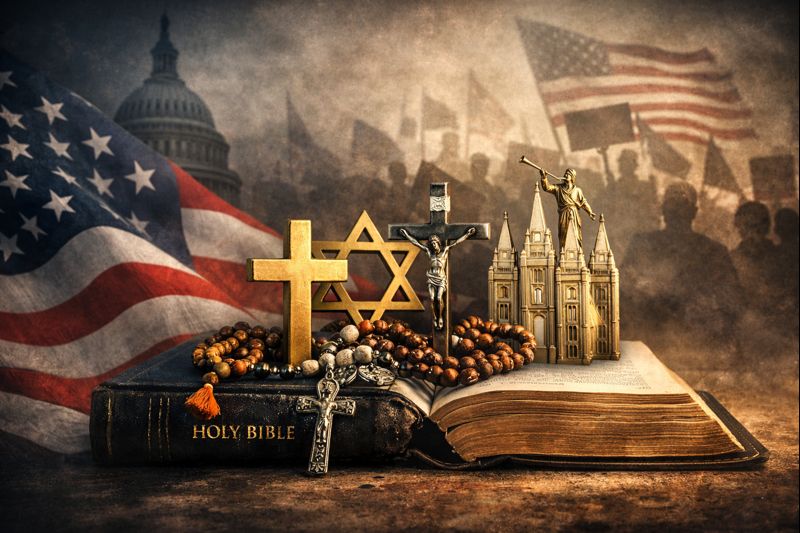
When Turning Point USA announced its 2025 tour schedule, discerning Christians began to notice the list of influential guest speakers with a diversity of faith values. Catholics, Mormons, Hindus, a host of NAR leaders, and even agnostics were all joining together in the name of religious unity.
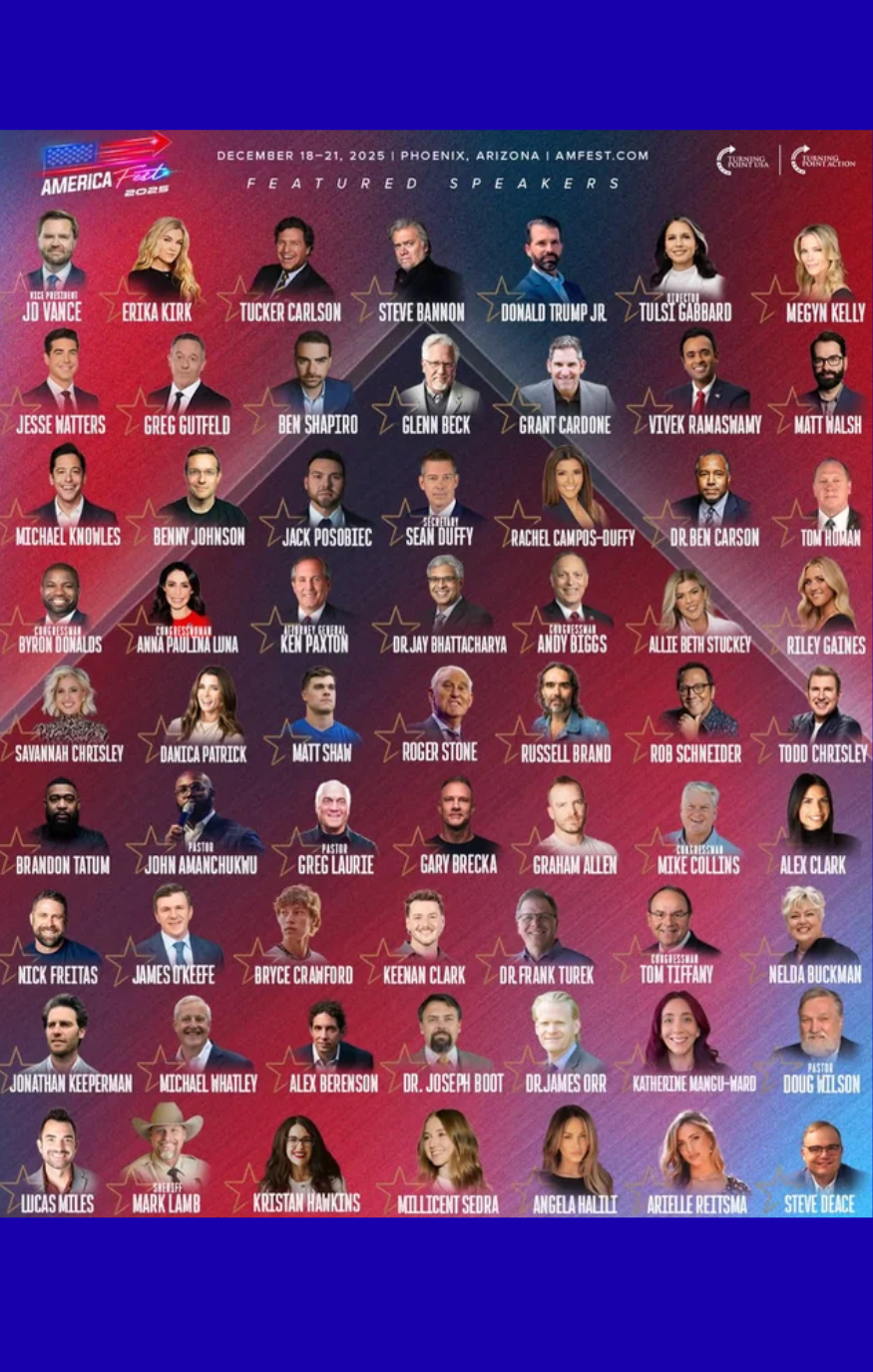
While participation in political events alone does not imply wrongdoing, the blending of these speakers on the same platform under the banner of a common unity in faith can blur theological distinctions that Scripture calls Christians to uphold.
The term Unity is biblical — but it only applies to unity grounded in the truth of Scripture! Unfortunately, Christians are increasingly being urged to set aside doctrinal differences and unite across theological lines for political or cultural goals. They’ll begin to treat discernment as “division.” As a result, many Christians react strongly — sometimes with protest — when church leaders or discernment ministries warn against ecumenical syncretism.
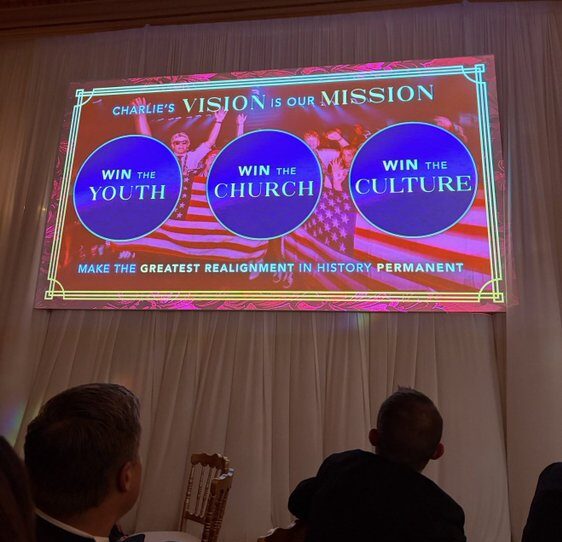 In the wake of Charlie’s death, TPUSA’s ecumenical Christian Nationalist efforts have accelerated, and I worry for the many young people who are not grounded in the Word of God, that they will fall into the trap of a false religion. Without solid biblical teaching, they may be drawn into movements that compromise the exclusivity of the Gospel. What makes this appealing is that many of the causes these faith organizations champion—such as opposing lawlessness and immorality — align with concerns many Christians, including me, share. It is important to speak out and vote accordingly. But the people and the organizations Christians partner with to do this matters. It matters to God that we not link arms with anyone who brings a different Gospel, even for causes we consider morally good — because God calls us to faithfulness first and foremost.
This is pragmatism: attempting to achieve what we believe is the best outcome, rather than faithfully obeying Scripture and leaving the results in God’s hands.
Examples of TPUSA’s ecumenical partnerships (illustrative, not exhaustive)
The Roman Catholic Church, and leaders who identify as Roman Catholic. In a nutshell: Roman Catholicism disagrees that our authority about God’s nature and character come from Sola Scriptura (Scripture Alone), and they add the Pope along with church traditions as having equal authority. They also hold doctrinal positions such as veneration of and prayer to Mary and other church leaders who have died, purgatory, works-based righteousness, and the belief that the Eucharist becomes the actual body of Christ. All this to say that the Roman Catholic presence at TPUSA’s faith-based events is a serious concern. Mixing faith and political zeal almost always leads to compromising the Gospel
Some of the Catholic speakers and panelists who have appeared at TPUSA events include: Father Will Schmidt; Kelsey Reinhardt, President & CEO of CatholicVote; Cindy Ketcherside from the Catholic Action Network; and Jack Posobik, a Catholic speaker at several events.
We’ve also seen media personalities bring their platforms to the stage, like Michael Knowles and Megyn Kelly.
And they are also bringing elements of worship and prayer, as if everyone on stage prays to the same God of the Bible. Jack Prosobiec even entered the AMFest stage holding up a rosary and leading Latin prayers.
There was also a eucharistic adoration ceremony at one of the breakout sessions. And as a side note, Charlie Kirk baffled his followers last year when he tweeted that he hoped the new pope would bring about a golden age: “I pray the new Pope will help usher in a new Golden Age of Christianity. If the new Pope defends the faith, defends the West, defends biology and eternal truths, I will be his biggest fan.”
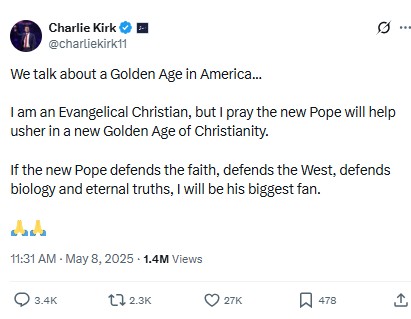
And it was just one week before his murder that Charlie Kirk reportedly confessed to a Catholic Bishop that he was an admirer of the Catholic church, and responded to speculation that he was contemplating converting to Catholicism, saying, “I’m this close.” There is also his podcast in which he said that evangelicals don’t venerate Mary enough. So yes, there has been a muddying of the waters for a long time now, and it is confusing.
If AmFest and all these other events were just about politics and political activism – fine, but these gatherings do have a faith purpose, and the fact that TPUSA is doing this under the banner of Jesus Christ — seems to me like they are using Jesus for power and clout.
Other ecumenical partnerships
TPUSA has partnered with several prominent Mormons (LDS), including Glenn Beck, Senator Mike Lee, Governor Spencer Cox, Representative Andy Bigg, and former Representative Jason Chaffetz. Charlie Kirk publicly praised Mormonism, stating in interviews that America needs a “strong Mormon church” for its moral values, despite theological differences.
TPUSA’s alliances with Mormons are often justified as shared conservatism, but they extend to joint political rallies and faith-based initiatives.
TPUSA events have also featured speakers from non-Christian faiths, including Vivek Ramaswamy (Hindu), Ben Shapiro (Jewish), and a rabbi leading a Shabbat dinner at AmFest.
7 Mountains of Dominance

There’s also a significant NAR influence at these events. Many NAR leaders at TPUSA events promote the Seven Mountain Mandate, one of the Hallmarks of the New Apostolic Reformation. The mandate claims that God wants Christians to take control of 7 areas of influence in our culture: The Economy, Government, Media, Arts/Entertainment, Education, Family, and the Church. Not to be merely an influence, but to control and reclaim those areas by force for Christ, as mentioned earlier. The Seven Mountain Mandate sounds compelling because it promises that your career, your influence, even your position can have eternal impact. It feels ambitious and spiritual, like you’re high up in God’s grand, kingdom-level plan. But here’s the danger: it shifts the church’s focus from surrendering to Christ to human control of an earthly kingdom, from obedience to ambition. Success becomes cultural influence, not faithfulness to the Gospel.
One more thing: keep your eye on a man named Rob McCoy. He is the Co-Founder and Co-Chair of TPUSA Faith, and is widely recognized for teaching the Seven Mountain Mandate and promoting dominionist perspectives within the NAR. He has been influential in encouraging TPUSA’s integration of Christian faith with social conservatism and political activism.
TPUSA Faith’s Biblical Citizenship classes encourage churches to engage politically, often partnering with NAR figures like Lance Wallnau, who is recognized as one of the key founders of the modern Seven Mountain Mandate teaching. Additionally, events like the Courage Tour blend revival-style worship with political speeches, featuring eclectic mixes of Protestants, Catholics, and Charismatics.
And its affiliations with platforms like FlashPoint are tied to Kenneth Copeland’s Word of Faith ministry.
Our ultimate goal should be the glorification of God’s holy name. And, that cannot be done by partnering with groups whose beliefs or practices diverge from Scripture. We should be cautious of any group that compromises in this manner just so they can achieve a worldly goal.
Whether TPUSA is knowingly acting with hidden agendas disguised as patriotism, or simply advancing its mission under the guise of patriotism, this raises serious concerns for Christians seeking to maintain doctrinal integrity. The blending of political activism with faith-based initiatives has created a complex situation requiring careful discernment.
Why is this a problem?
Ecumenical Syncretism compromises on core doctrines by watering down the exclusivity of Christ as the only way to salvation. When you partner with groups like Catholics or Mormons or Hindus, it implies theological equivalence – as in we are all the same. But we are not the same. This just undermines Sola Fide (faith alone) and Sola Scriptura (Scripture alone).
Scripture warns against alliances with unbelievers or false teachers, and as 2 Corinthians 6:14 reminds us, “What fellowship has light with darkness?”. Platforming anyone with a different gospel risks apostasy. 2 Timothy 4:3-4 warns that, “a time is coming when people will not endure sound teaching, but having itching ears they will accumulate for themselves teachers to suit their own passions, and will turn away from listening to the truth and wander off into myths.”
Many ecumenical movements start with noble intentions, such as seeking to protect or improve society, but history shows that compromising core doctrines often leads to unintended doctrinal drift and – in some cases – a deconstruction of faith entirely. Christians must continually test all partnerships and initiatives against God’s Word to ensure faithfulness and avoid compromise.

Excellent article!
Thank you – it took a long time to compile. Glad it was helpful!
Amy—-would love to chat with you. There is so much bleed to this corporate conglomerate “TP.” https://www.tiktok.com/t/ZP8f9vmor/
-Sarah 856-866-6881 (GA)
On CN’s specific identity/theological/political ideology that seeks to ‘bring the Kingdom of God to earth’:
For many, this has direct ties to their post-mill eschatology. While it isn’t the same as the Kingdom Now or NAR folks, it does impact their view of what the purpose and point of “Thy Kingdom Come…on earth as it is in heaven” means.
I agree. Not enough people are discussing the ramifications of the post-mil ideology. People want to say: “one’s eschatology is tertiary! It doesn’t matter to the main thing, to the Gospel.” But, it does matter. Truth matters, always.
You are 100% correct. Tertiary issues that make praxis incongruent with orthodoxy are no longer terriary issues, but primary.
From 2019-2022, I was being recruited, with my wife, into the Fellowship (aka ‘The Family’). Our task was to “Christianize” the country of Iceland, a place where we serve on occasion as missionaries. Our (former) mentor showed us Mat 24:14 and told us that Jesus won’t come back until we “Christianize” all the countries on the map. Our God-given task was Iceland; the 7MM was the playbook. I was to infiltrate the segments of that small nation through my vocation as a scientist and through my hobby, golf.
Thankfully the Holy Spirit opened our eyes to the deception and distraction from making disciples. This stuff is very real.
Wow!
Thank you! If more understood the danger, they would understand that this is not an attack on TPUSA or Charlie, but FOR the glory of God.
And what about Candace Owens? Where do you think she fits in? And what about Victor Marx, CK’s close friend, on the plane when CK’S body was brought ba k to AZ And now he is the number 1 candidate in fund raising to become Colorado’s next Governor.
That is not the focus kf this article.
I intentionally left C.O. out of this article.
Very good article and much needed. The only thing I would add about the RCC influence is that it was the RCC that changed God’s Saturday Sabbath to Sunday sabbath in honor of the sun-gods, “the Venerable Day of the Sun”. They claim they did it on their own authority because the Popes are God in the flesh and can do such things—it’s in their own writings, do the research.
In the New Testament – the first day of the week was Sunday. That was the day the early Christian Church got together to meet.
Which is the first day of the week in the Bible?
In the Bible, the first day of the week is Sunday. This is based on the account of the resurrection of Jesus Christ, which took place on a Sunday according to the Gospels.
What does the Bible say about the first day?
In the Bible, Genesis 1:5 describes the first day of creation as follows: “God called the light ‘day,’ and the darkness he called ‘night.’ And there was evening, and there was morning—the first day.” This passage signifies the beginning of God’s creative work, where He separates light from darkness to establish day and night. The concept of the first day in the Bible serves as the foundation for the subsequent days of creation as outlined in the book of Genesis.
Where does the Bible say to meet on the first day of the week?
In the Bible, it is mentioned in Acts 20:7 where it says:
“On the first day of the week, we came together to break bread. Paul spoke to the people and, because he intended to leave the next day, kept on talking until midnight.”
I’ve sat and watched this transpire and it’s been concerning. I never followed Kirk or TPUSA and have researched more now about how all of this came to be. Why in the world would well known pastors join in this? This is about money, nothing more.
Thank you for this article and setting the truth straight. I didn’t know this as I’m sure many do not also. I now understand it clearly through your excellent research. It saddens me that Charlie started to think about changing some of his thoughts about Christianity just before he passed. It would have “muddied the waters” and not be biblically or scripturally sound. I pray Turning Point USA turns to a better path. I used to be a Catholic years ago but now know the difference between Christianity and Catholicism as well as other faiths. Let’s keep it the way it was meant to be as stated in God’s word, the bible, and his son, Jesus Chri
Should be “Jesus Christ”. It got cut off.
Thank you, Amy, for this excellent article! Great job!
Perhaps the Lord took Charlie to heaven when Charlie was at his very best, to protect him from what TPUSA was evolving into and to keep him in the faith and not be deceived into stepping into and accepting the deception of Catholicism.