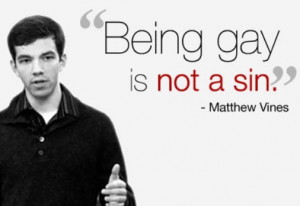
One of the most effective ways false teaching slips into a church isn’t through outright denial of biblical truth. More often, it comes disguised in familiar Christian language that sounds fine at first glance.
 When looking for a solid church to attend, most of us start with the statement of faith or the “We Believe” tab on the church website. At first glance, everything sounds rock solid. Foundational doctrines are accurate. The Gospel seems clear. And then we attend – or even join – this church, and we find out that what is actually taught is very different from what we saw online. We discover that the historic, biblical meanings have been quietly swapped out for something else entirely.
Years ago, while researching various ministries, I learned that reading a church’s statement of faith was only the beginning of discernment. Many organizations have beautifully written doctrinal statements. They affirm Scripture. They affirm Jesus. They affirm the Gospel. Yet after listening to their sermons, reading their books, or attending their conferences, a different theology emerges.
Here is an example of a church you might consider attending based solely on its online statement of faith:
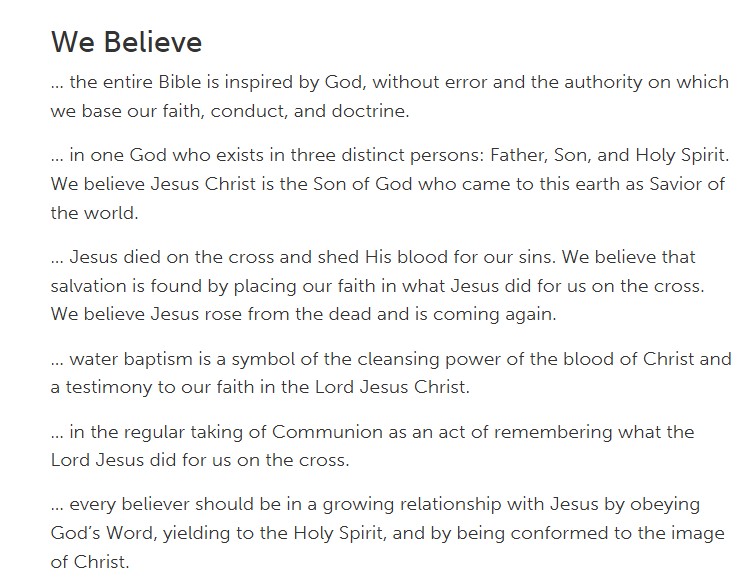
I used this example years ago while hosting a Christian radio program. I read the statement aloud and asked listeners whether they would feel comfortable attending a church that held these beliefs. Most agreed that the statement sounded thoroughly evangelical and doctrinally sound.
Then I revealed the source.
The statement came from Joel Osteen’s ministry site.
Many listeners were surprised. On paper, the statement affirms a number of essential Christian doctrines. Yet anyone familiar with his preaching knows that Joel Osteen is a wolf in sheep’s clothing who is deceiving millions with his prosperity theology and Word of Faith teaching, emphasizing health, wealth, positive declarations, and self-empowerment rather than the biblical gospel of repentance and faith in Christ.
The exercise illustrated an important lesson: a church’s statement of faith is only a starting point. The problem with beautifully written belief statements aren’t usually the words. The problem is the definitions. A church website may affirm the gospel. A speaker may talk about repentance. A ministry may emphasize justice, unity, love, or mission. This is one reason discernment matters.
To understand what a ministry truly believes, we must look beyond its published doctrine and examine its preaching, teaching, recommended resources, and the fruit of its ministry. Sometimes the words remain orthodox while the meanings attached to them have subtly shifted.
As Christians, we’re called to contend for the faith once for all delivered to the saints (Jude 3), not because we’re looking for controversy, but because truth matters. The Apostle Paul repeatedly urged believers to hold fast to sound doctrine, knowing that error rarely arrives wearing a name tag.
Instead, it often borrows the language of Christianity while redefining the terms.
An Old Strategy in a New Package
This tactic is not new. The serpent’s first recorded words in Scripture were designed to create confusion about what God had said. “Did God actually say…?” (Genesis 3:1).
Satan didn’t begin by openly rejecting God’s Word. He questioned it, reframed it, and subtly altered its meaning.
Throughout Scripture we see the same pattern. False prophets claimed to speak for God. The Pharisees added traditions that distorted God’s commands. The Judaizers in Galatia preached what Paul called “another gospel” (Galatians 1:6-9), though they undoubtedly believed they were improving upon the truth.
Error often succeeds because it sounds close enough to the truth to avoid immediate detection. That’s still happening today.
When Christian Words Stop Meaning Christian Things
Many of the theological battles facing the church today involve definitions.
Take the word repentance. Historically, Christians have understood repentance to mean turning away from sin and turning toward Christ. It involves sorrow over sin, confession, and a transformed life produced by God’s grace.
Yet in some circles, repentance is redefined as merely changing one’s perspective, becoming more self-aware, or embracing one’s authentic self. Sin becomes secondary. Personal fulfillment becomes central. The word remains. The meaning shifts.
Or consider the word love. Scripture teaches that love rejoices with the truth (1 Corinthians 13:6). Biblical love seeks another person’s highest good, which includes pointing them toward obedience to Christ.
In many evangelical, nondenominational, and other Progressive churches today, love is often redefined as unconditional affirmation. To question someone’s beliefs or behavior is viewed as unloving, regardless of what Scripture teaches.
Again, the word remains, but its biblical content is emptied out and replaced. We see similar shifts with words like justice, unity, inclusion, prophecy, and even gospel.
Why Definitions Matter
Some Christians may wonder whether these distinctions are simply arguments over semantics.
They’re not. Doctrine is communicated through words. If the meanings of those words change, doctrine changes with them.
Imagine two people using the word “gospel.” One means that Christ died for sinners, was buried, rose again, and offers forgiveness and reconciliation with God through faith alone. The other means social transformation, community improvement, or human flourishing.
Both may use the same word, but they’re describing very different messages.
The Apostle Paul understood the importance of precise language. He instructed Timothy to “follow the pattern of the sound words” he had heard (2 Timothy 1:13). He warned against teachers who did not agree with the “sound words of our Lord Jesus Christ” (1 Timothy 6:3).
The early church cared deeply about doctrinal clarity because words communicate truth.
When biblical definitions are lost, biblical doctrine soon follows!
Common Patterns of Redefinition
While doctrinal drift takes many forms, certain patterns appear again and again.
One common pattern is softening:
– Sin becomes “brokenness” or “mess.”
– Rebellion becomes “woundedness.”
– False teaching becomes a different perspective.
Now, certainly people are broken and wounded. Scripture acknowledges that reality. But when sin disappears from the conversation, so does the need for repentance and redemption.
Another pattern is expansion:
Words are stretched beyond their biblical boundaries and filled with concepts borrowed from secular ideologies.
Justice, for example, is a profoundly biblical concern. God cares about justice. Christians should care about justice.
But when secular theories become the framework for defining justice, biblical categories are often replaced with cultural ones. The word remains, yet the foundation underneath it changes.
A third pattern is substitution:
– Biblical authority is replaced by personal experience.
– Discernment is replaced by emotional reactions.
– Prophecy becomes impressions and feelings that may or may not be true.
– Unity becomes agreement at the expense of truth.
In each case, familiar language provides cover for unfamiliar theology.
Discernment Begins with Questions
So how should Christians respond?
Not with suspicion toward every new phrase. Not with cynicism. And certainly not with a desire to win arguments.
Instead, we should learn to ask good questions.
When we hear a teacher use an important theological term, we should ask:
– How does Scripture define this word?
– How has the church historically understood it?
– Is this teacher using the term consistently?
– Does the definition align with the plain teaching of God’s Word?
– Most importantly, what happens if this definition is followed to its logical conclusion?
Holding Fast to the Truth
We live in a noisy age. Information reaches us from podcasts, social media, conferences, influencers, books, and countless online ministries. Many voices claim to represent biblical Christianity.
Some do. Some do not.
This reality makes discernment more important than ever.
The Bereans in Acts 17 were commended because they examined the Scriptures daily to see whether what they were hearing was true. They did not reject teaching out of hand, nor did they accept it uncritically. They measured everything against God’s Word.
That remains our responsibility today. The solution to doctrinal confusion is not greater suspicion but greater biblical literacy.
When we know what Scripture teaches, we become better equipped to recognize when familiar words have been given unfamiliar meanings.
Sound doctrine cannot survive if biblical definitions are abandoned.
For the sake of Christ’s church, we must hold fast not only to biblical words but also to the biblical truths those words were given to communicate.