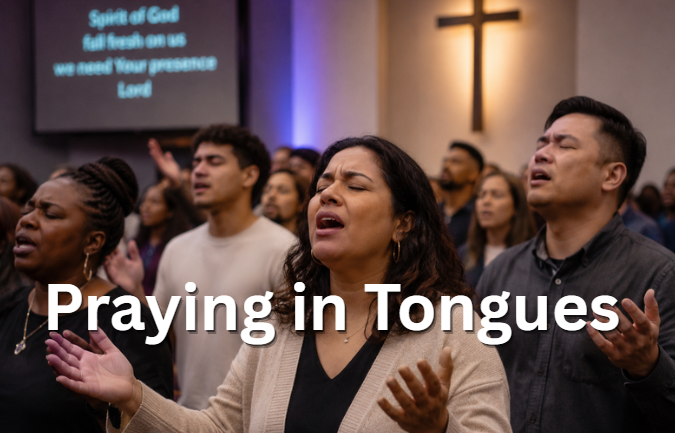
I recently received a letter from a women’s ministry asking about speaking in tongues, after several of the group’s members discussed their own personal experiences praying to God in a private prayer language. Additionally, because the New Testament seems to be encouraging tongue-speaking in church, they asked if this gift was still alive and practiced biblically today. Great questions!
Tongues that sound like unintelligible speech or gibberish became popular in the late 1800s with the rise of Pentecostal and Charismatic movements, after many centuries in which the Church was largely silent regarding such practices.
Biblically, the gift of tongues was given by the Holy Spirit as a sign gift. Along with other miraculous gifts given to believers such as healing and raising the dead, sign gifts served to authenticate the message of Christ and point people to His divine authority.
In Acts 2:4-21, the gift of tongues consisted of real human languages. The Holy Spirit enabled believers to speak languages they had never learned so that people from many nations could hear the Gospel in their own language. Some observers thought the speakers sounded like they were drunk, but Peter corrected them and explained what was actually taking place. He told them that Joel’s prophecy (Joel 2:28) was manifesting in that miraculous moment.
Scripture also gives specific instructions regarding tongues in the church: “If anyone speaks in a tongue, it should be by two or at the most three, and each in turn, and one must interpret; but if there is no interpreter, he must keep silent in the church” (1 Corinthians 14:27-28). This passage suggests that tongues were not intended as a private prayer language but as a means of communicating God’s truth to others. In Scripture, tongues functioned as a sign for unbelievers (1 Corinthians 14:22) and consistently pointed people to the Gospel (Acts 2:6-11).
When Paul addressed the Corinthian church, he was correcting practices that had become disorderly and confusing. His emphasis was that Christian worship should be characterized by clarity, intelligibility, and order.
Jesus also taught His followers how to pray, and how not to pray. In the Lord’s Prayer (Matthew 6:9-13, Luke 11:2-4), He modeled clear and understandable communication with the Father. In fact, Jesus specifically warned against meaningless repetition:
“And when you are praying, do not use meaningless repetition as the Gentiles do, for they suppose that they will be heard for their many words” (Matthew 6:7).
The Greek word translated “meaningless repetition” is battalogeo, which carries the idea of babbling, empty phrases, or repetitive speech without understanding. Throughout Scripture, God’s people are encouraged to pray and worship with understanding rather than unintelligible utterances.
Some proponents of modern tongues point to 1 Corinthians 13:1, where Paul mentions the “tongues of men and of angels,” as evidence for a heavenly prayer language. However, whenever angels speak in Scripture, they do so in understandable language. There is no example of an angel communicating in an unintelligible heavenly tongue. Likewise, Jesus, the apostles, the psalmists, and other biblical writers prayed in clear, understandable language.
It is also worth noting that tongue-like phenomena are not unique to Charismatic Christianity. Similar experiences can be found in various non-Christian religions and spiritual practices, which means that an experience alone is not sufficient proof that something is from God. Scripture must always be our standard for evaluating spiritual claims.
Finally, whenever someone shares experiences such as speaking in tongues, visions, or hearing voices, I do not immediately question the sincerity of their experience. Such experiences may feel very real to them. Rather, I try to gently point them back to Scripture and discuss what God’s Word teaches about these things whenever the opportunity arises.
Are these experiences truly from God? No one can say with absolute certainty about any particular person’s experience. While I won’t question the sincerity of those who have had such experiences, the key question remains: Are these practices biblical? Scripture must be our final authority. If we cannot clearly support a spiritual experience or practice from the Bible—rightly interpreted and in context—then we should not pursue or promote it as normative for the Christian life.